QuickBooks is a fantastic tool. It helped you get off paper ledgers, track your early cash flow, and file your first tax returns. For a startup or a small service business, it is often the perfect starting line.
But businesses grow. And when they do, the software that helped you start can quickly become the very thing holding you back.
At IpsumTek Consult Ltd, we regularly help East African companies make the leap from basic accounting software to a full Enterprise Resource Planning (ERP) system. How do you know when it is time to make the jump to Microsoft Dynamics 365 Business Central? Here are the clear signs.
1. The Rise of "Shadow IT" and Spreadsheets
QuickBooks is great at tracking money, but it is not designed to manage complex operations. When your team needs to track something QuickBooks cannot handle, they do not stop working. They just open Excel.
Suddenly, your inventory is tracked in one spreadsheet, your sales pipeline in another, and your project costs in a third. Your finance team spends the last week of every month manually copying and pasting data between these sheets and QuickBooks.
The Business Central Fix: Business Central replaces these disconnected spreadsheets with a single, unified database. Your sales, inventory, projects, and financials all live in one place. When a sale is made, your inventory and general ledger update automatically. No more copy-pasting. No more version control nightmares.
2. The Inventory and Operations Disconnect
As you scale, your supply chain gets more complex. You might have multiple warehouses, need to track batch numbers for expiry dates, or manage complex bills of materials for manufacturing.
QuickBooks handles basic inventory, but it cannot easily tell you if a specific batch of raw materials is sitting in Warehouse B while Warehouse A is out of stock. It lacks the deep operational visibility a growing business needs.
The Business Central Fix: Business Central unifies your financials with your physical operations. It offers advanced inventory management, multi-location tracking, assembly and manufacturing capabilities, and real-time visibility across your entire supply chain. You finally get a single source of truth for both your money and your goods.
3. The Compliance Headache (eTIMS and Beyond)
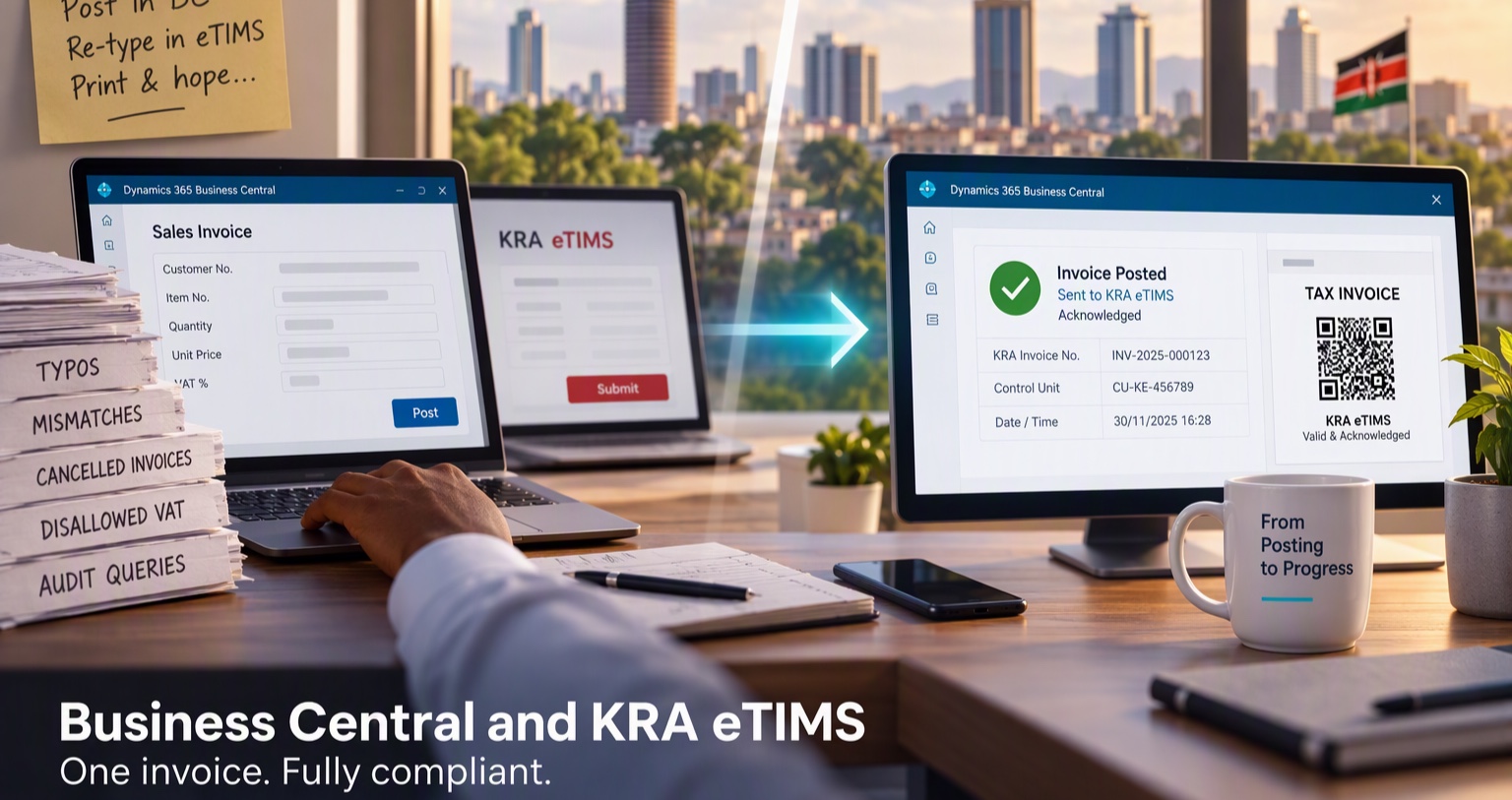
Tax authorities are digitizing rapidly. In Kenya, the KRA eTIMS mandate requires real-time transmission of invoice data.
Trying to force QuickBooks to talk to eTIMS usually results in clunky, third-party workarounds or, worse, manual re-keying of invoices into the KRA portal. This introduces human error and compliance risk.
The Business Central Fix: Business Central is built to handle complex compliance requirements. Through proper integration, it can map your tax codes and transmit data automatically to KRA at the point of sale. It ensures your VAT returns match your actual posted invoices, keeping you fully compliant without the manual headache.
4. Scaling the Team and Branches
When you had five employees, everyone knew what was happening. Now you have thirty, and you have opened a second branch.
You need strict role-based security. Your sales team should see customer orders but not the company’s bank balances. Your warehouse manager should see stock levels but not payroll data. QuickBooks has limited user permissions, making it risky as your team expands.
The Business Central Fix: Business Central allows you to design granular, role-based security profiles. You can give employees access to exactly what they need to do their jobs, and nothing more. It also makes consolidating financials across multiple branches or entities seamless.
Why Business Central is the Perfect Next Step
Moving from QuickBooks to an ERP is not just about fixing problems; it is about unlocking your next phase of growth. Business Central is the ideal upgrade path for several reasons:
- Familiar Interface: It looks and feels like Microsoft Outlook and Excel. Your team will adopt it much faster than a clunky, traditional ERP.
- True Cloud Scalability: It grows with you. You can add new modules, users, and branches without needing to buy new servers or upgrade your hardware.
- Powerful Automation: Built-in AI and automation handle routine tasks like invoice processing, cash flow forecasting, and anomaly detection, freeing your team to focus on strategy.
Conclusion
Moving away from QuickBooks is not a sign that your current software failed. It is a sign that your business has succeeded and evolved.
Upgrading to Microsoft Dynamics 365 Business Central replaces manual workarounds with automated, scalable processes. It gives you the visibility, control, and compliance you need to make confident decisions for your future.
At IpsumTek Consult Ltd, we specialize in helping East African businesses migrate from basic accounting tools to tailored Microsoft ERP solutions. If you recognize these signs in your business, let us talk. Reach out to our consultants at consult@ipsumtek.dev for a Business Central readiness review.